26th Division Chronicles
The story of Alberto C. Gomez Llata
"Albert Gomez"
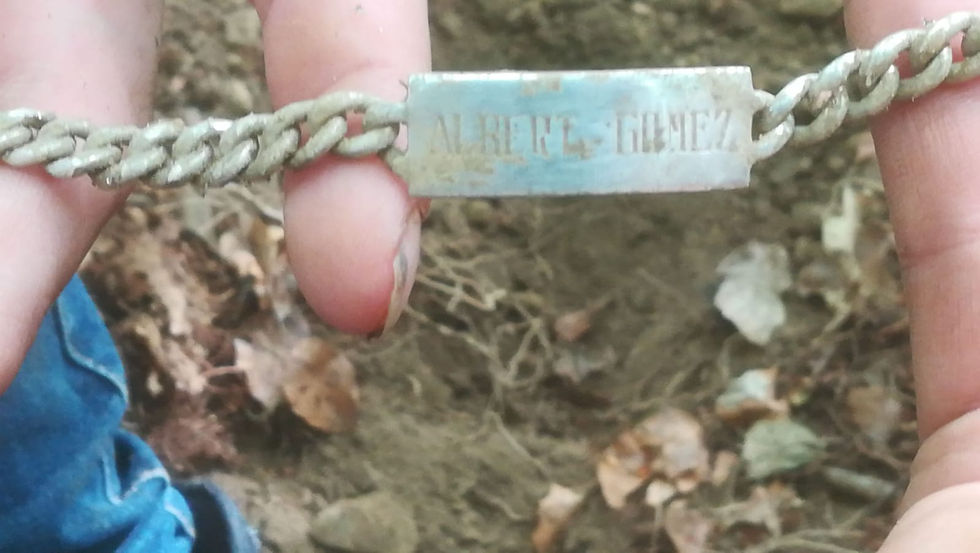
After arriving at our camp site I quickly started searching for the owner of the bracelet. Without any luck, My simple google search at the time concluded in zero hits. After some digging, figurally not literally, I was able to find out that we had been digging in the B company sector of the 101st infantry regiment that day. Many thanks to Phil Lusk (son of Don Lusk, C company 104th infantry regiment) for sending me the overlay that day. While going through the 26th divisional history book we came across the name Alberto C. Gomez Llata and quickly more pieces fell into place confirming that “our” Albert Gomez was for a fact Alberto C. Gomez Llata.

.jpeg)
Albert was born in Mexico city, Mexico on september 18th 1917, and was the oldest one of the four kids. Their father who had the exact same name as Alberto was assassinated right when the Mexican civil war ended. After immigrating to the United States during the great depression, he lived and worked with his brother in Texas. His brother Alfonso later served as a heavy machine gunner with the 5th infantry division in Luxembourg and Germany. When WW2 started the brothers decided to enlist on the 23rd of December 1942. His family told me the reason they enlisted was because all their friends enlisted too, and it was ''unmanly'' to stay home, if you could go fight.
Albert and alfonso before going overseas.

frontside, "Albert gomez"
(pictures taken while finding the bracelet. Also note the m1 garand buckle on the right, one of many. also a couple of pieces of shrapnell were found inside the foxhole.)
.jpeg)


Hill 490:
After the 1st battalion secured Bavigne, the 101st infantry regiment would start an offensive attack towards hill 490 and the schumann crossroad which the Germans used to resupply the troops on the push to Antwerp. while the 2nd battalion cleared the town B company with the 1st battalion cleared the left flank of the town.
B company reached a wooded slope where they attacked the Germans resulting in 2 days of hand to hand combat with the line going back and forth. After finally gaining a foothold on the slope and digging in they rested for a couple of hours until the germans counter attacked again at dusk. An officer from another company recalled: ''we could hear the fighting of B company on our left and some platoons were so scared they retreated, we quickly picked them up and placed them back on the line.'' Some of the attached machine gunners from D company were credited with killing more than 150 Germans with their watercooled .30 caliber machineguns. Sgt. Watkins with D/101 recalled the counterattack: “they seemed drugged, they came out of the brush, straight for us, holding their rifles and staring right at our machine guns. We burned one gun out, firing so fast.” As the fighting developed into hand to hand combat they were able to hold the line and break up the counterattack. During the rest of the night the company was heavily shelled by German Nebelwerfer rockets. Albert was hit by German nebelwerfer shrapnell, inside his foxhole Sgt. Heslin tried to help Albert, Albert was hit in his elbow and wrist. While trying to stop the bleeding the bracelet was ripped from his arm. resulting in the clasps being bent.
During or after being treated Alberto got hit in his head by Shrapnell and died instantly right there in his foxhole. He was listed missing in action due to the constant fighting and the line going back and forth. His body was recovered in March 1945 after the battle moved on. And was officially declared killed in action and buried in the temporary cemetery at Foy, Belgium before being returned to his hometown in Mexico.
In 2022 a memorial was placed next to his foxhole by us together with the family of Albert. Albert will never be forgotten.
.jpeg)
Texas to the bulge:
After going through basic training Albert spent some time
with the coastal artillery and ordnance battalions. Albert
would eventually be transferred to a replacement depot inlate 1944. From there he would join B company of the 101st infantry regiment, 26th infantry division On December 18, 1944. The division had just entered its rest period but on the early morning of 20th of December at 01:00AM they started to move towards Luxembourg to assist in pushing back the massive German attack from December 16, later known as the battle of the bulge. B company and the rest of 1st battalion would be moved up to Steinfort, Luxembourg where they outposted on the east side, guarding roadblocks and securing the flank of the entry position for the division to enter combat again. Here they stayed for 2 days until ordered to move up north. The 1st battalion was relieved from corps reserve and moved toward Noerdange where they spent the night. The next day the battalion was moved up to Ell where they secured the left flank. The regiment was able to spend a relatively quiet Christmas evening. On December 26 at 04:00AM 1st battalion relieved the 328th infantry regiment near Bonnal. Here the combat engineers would construct a bridge across the Sure river. and the first crossing was made at 11:15AM. The town of Liefrange was secured and they dug in on the high ground outside of the town.
Backside, "Carrie"